 Jeff McGilligan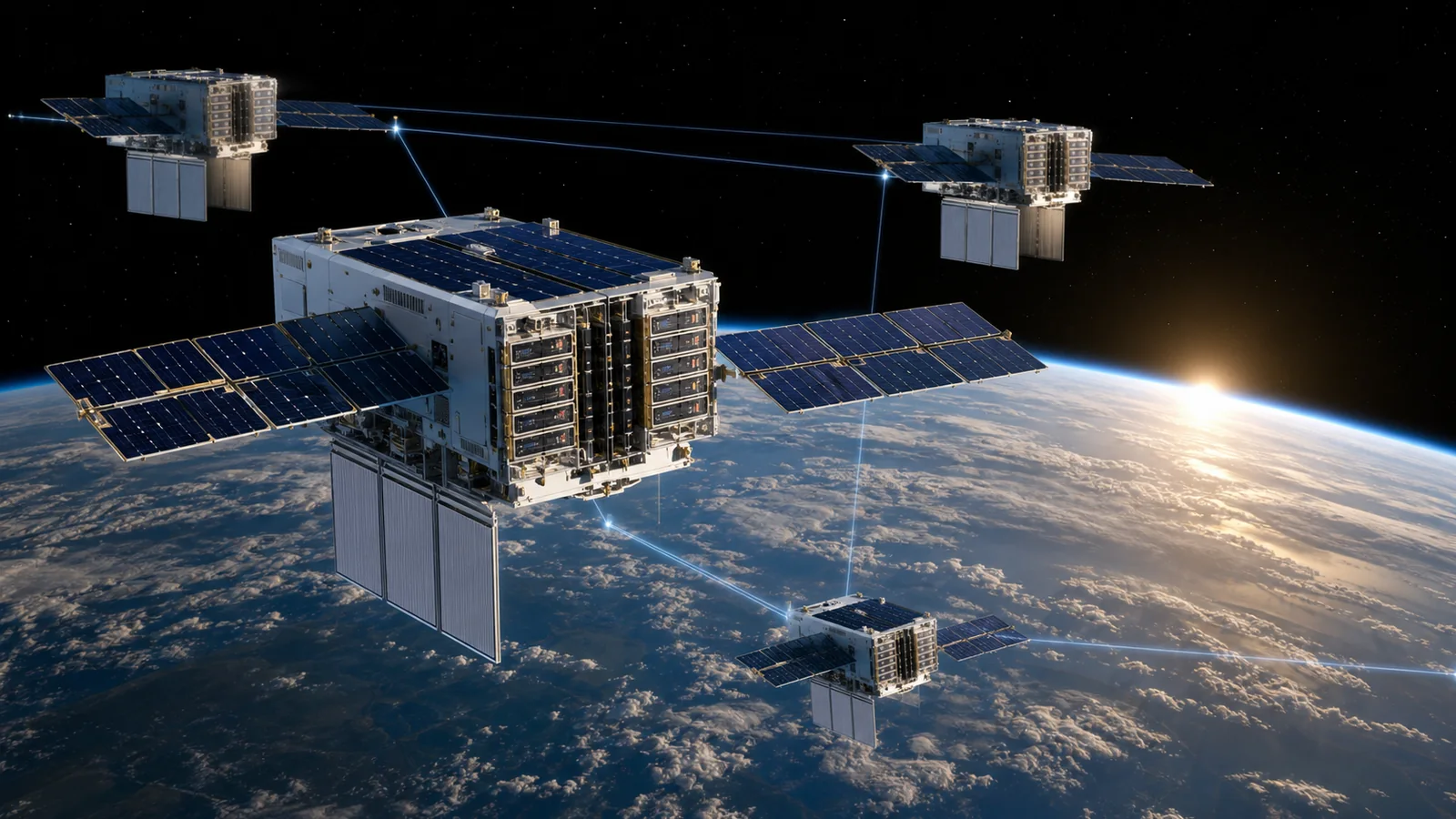
By Jeff McGilligan, ReadBasket
AI data centers in space are no longer a throwaway sci-fi line. They are becoming a serious answer to a very Earth-bound problem: the AI industry is running into limits of power, land, cooling, chips, launch economics and public patience.
The timing is not accidental. Google has already announced Project Suncatcher, a research moonshot that imagines solar-powered satellites carrying TPUs and linked by optical connections. TechCrunch reported on May 12, 2026, that Google and SpaceX are in talks about putting data centers into orbit. Starcloud has raised major funding for space-based compute and says it has already flown an Nvidia H100-class GPU in orbit. SpaceX, meanwhile, has filed an ambitious FCC proposal for an “Orbital Data Center” system that could involve up to one million satellites.
That does not mean the internet is about to move above the clouds. The first realistic future is narrower and more interesting: orbital compute may become a specialized layer for AI workloads that are born in space, need constant solar power, or benefit from being physically far away from terrestrial grids. If it works, it could change satellite intelligence, climate monitoring, defense systems and some forms of delay-tolerant AI processing. If it fails, it will probably fail for old-fashioned reasons: cost, heat, maintenance, debris and regulation.
Why AI Companies Are Looking Up
The simplest reason is energy. The International Energy Agency says data centers used about 415 TWh of electricity in 2024, around 1.5% of global electricity consumption. By 2030, the IEA expects that figure to more than double to about 945 TWh, slightly more than Japan uses today. In the United States, data centers are projected to account for nearly half of electricity-demand growth between now and 2030.
That is why orbital data centers have suddenly become a serious boardroom thought experiment. In the right low Earth orbit, solar panels can receive near-continuous sunlight. There are no neighborhood zoning fights, no local water-use backlash, and no grid interconnection queue in the normal sense. For an industry where a new AI data center can consume as much power as a small city, space starts to look less like escapism and more like an extreme infrastructure option.
Google’s own Project Suncatcher work frames the opportunity clearly. The company says solar panels in the right orbit can be far more productive than panels on Earth, and its research explores compact constellations of satellites carrying Google TPUs, connected by free-space optical links. Google also plans a learning mission with Planet to launch two prototype satellites by early 2027 to test TPU hardware and optical inter-satellite links in orbit.
What An Orbital AI Data Center Might Actually Be
The phrase “data center in space” makes people imagine a floating warehouse full of server racks. That is probably wrong. A more realistic design is a constellation of smaller satellites, each carrying compute hardware, solar arrays, thermal radiators, storage, radios and optical links. Think less “warehouse” and more “power-dense spacecraft network.”
- Power: large solar arrays collect energy in orbit, with batteries reduced in orbits that stay close to constant sunlight.
- Compute: GPUs, TPUs or specialist AI accelerators run inference, preprocessing and selected training jobs.
- Networking: optical links connect satellites to one another, while ground stations move data between orbit and Earth.
- Cooling: heat must be conducted to radiators and emitted as infrared radiation, because there is no air in space to carry it away.
- Operations: software schedules workloads around sunlight, thermal limits, communications windows, hardware faults and orbital position.
That last point matters. A terrestrial data center can swap a failed part, add capacity, upgrade a network card or send technicians into the building. A satellite cluster has to tolerate faults, work around radiation damage and survive without easy repairs. The business case only works if the system delivers enough useful compute-hours over its lifetime to justify the launch and spacecraft cost.
The First Useful Workloads Will Be Space-Native
The biggest mistake is to assume orbital AI needs to replace Amazon, Microsoft or Google cloud regions on Earth. The more obvious first market is data that is already in orbit. Earth-observation satellites, radar platforms, weather satellites, defense sensors and space stations generate enormous amounts of raw information. Today, much of that data has to be downlinked before it can be analyzed at scale.
Running AI inference in orbit could filter images, identify ships, spot wildfire signatures, classify storm damage, compress radar data or flag unusual activity before the data ever reaches a ground station. That is powerful because bandwidth from orbit to Earth is limited and expensive. If a satellite can decide what matters before sending it home, the whole system becomes faster and more useful.
For everyday consumer AI, the case is harder. A chatbot request from a laptop in Chicago does not naturally belong in orbit unless the cost, energy and latency numbers beat terrestrial infrastructure. That may happen for some delay-tolerant inference or batch workloads, but it is not the first obvious win.
The Solar Power Case Is Real, But Not Free
Space-based solar power is the strongest argument for orbital compute. Above the atmosphere, solar panels avoid clouds, weather, dust and night cycles in certain orbits. A dawn-dusk sun-synchronous orbit can keep a satellite in sunlight for most of its path, reducing the need for heavy batteries and giving compute hardware a steadier energy source.
But sunlight is only one part of the bill. The satellite still has to be built, launched, insured, controlled, cooled, protected from radiation and eventually deorbited. The solar array has mass. The radiators have mass. The shielding has mass. Every kilogram has to get to orbit. That is why nearly every serious orbital compute plan depends on cheaper, more frequent heavy-lift launches.
Google’s Suncatcher research has suggested that launch costs may need to fall sharply before space-based AI compute can compete broadly with terrestrial data-center economics. That is the quiet hinge of the whole idea. If launch costs collapse, orbital compute becomes much more interesting. If they do not, it stays limited to high-value niches where the work really does need to happen in space.
Cooling Is The Problem Everyone Underestimates
People often say space is cold. For a data center, that is the wrong mental model. Space is a vacuum, which means there is no air to carry heat away. A server on Earth can move heat into air or water. A server in orbit has to conduct heat into a radiator and radiate it away.
That works for small systems. It becomes a brutal design constraint at data-center scale. AI accelerators generate serious heat, and high utilization is the whole business. A satellite data center cannot simply bolt on a bigger cooling tower. It needs large radiator surfaces, careful thermal control and workload scheduling that respects temperature limits. In practice, the shape of the machine is dictated by heat.
This is where the future may look strange. A successful orbital data center may not resemble anything built on the ground. It could be thin, modular, radiator-heavy and spread across many satellites, with software deciding where each workload runs based on power, heat, link quality and hardware health.
Latency Is Manageable For Some Jobs, Terrible For Others
Low Earth orbit is much closer than most people think. The raw light-speed delay from a satellite hundreds of kilometers up is measured in milliseconds, not the half-second feel of older geostationary satellite internet. That means latency is not automatically fatal.
The real network problem is messier: ground-station availability, weather on optical links, handoffs between satellites, queueing, routing, regulation and the need to bring results back reliably. Large-scale AI training also requires many accelerators to communicate tightly with one another. That is difficult in orbit unless the links are exceptionally fast and stable.
So the likely split is simple. Independent inference jobs, sensor preprocessing, disaster monitoring and batch analysis are plausible. Giant synchronized training runs are much harder. If a company says orbital AI will immediately replace terrestrial AI factories, it is probably selling the dream before the engineering catches up.
The Debris Question Is Not A Footnote
SpaceX’s orbital data-center filing shows how fast the debate could become political. TechCrunch reported that SpaceX is seeking federal approval for up to one million solar-powered satellite data centers. That number is not an approval; it is a proposal. But it is large enough to force a serious public conversation.
Low Earth orbit is already crowded. More satellites mean more collision-avoidance work, more end-of-life disposal obligations, more re-entry questions, more radio and optical interference concerns, and more pressure on astronomy. The American Astronomical Society has already pushed back against the SpaceX proposal, arguing that the scale could create risks for astronomy, radio-frequency interference and the orbital environment.
This matters because orbital compute can only become credible if it does not damage the orbital commons. If the sector creates a debris or light-pollution backlash, regulators may slow it down long before the economics get interesting.
The Future Possibilities
The most believable future is hybrid. Earth keeps the majority of AI compute because terrestrial data centers are easier to build, maintain and upgrade. Orbital AI becomes a specialist layer for the workloads where space has a genuine advantage.
- Climate intelligence: satellites process storms, fires, ice, crops and methane signals faster, sending only the most useful data back to Earth.
- Disaster response: orbital AI helps identify damaged roads, flooded neighborhoods, fire fronts and emergency landing zones before ground networks recover.
- Defense and security: space-based sensors process data on orbit, which could speed up warning systems and make infrastructure more resilient, but also more strategically sensitive.
- Remote connectivity: satellite networks with onboard AI could manage traffic, routing and edge inference closer to users in remote regions.
- Scientific missions: spacecraft could analyze data locally instead of waiting for narrow communication windows back to Earth.
- Resilient archives: some organizations may pay for orbital backup or sovereign storage, although the legal and practical questions are not simple.
The boldest version is a genuine orbital compute economy: data-center satellites assembled and serviced in space, powered by sunlight, upgraded by robotic missions and connected through laser mesh networks. That is a 2040s story, not a 2026 story. The near-term story is prototypes, demonstrations, niche customers and a lot of engineering lessons.
Who Wins If This Works?
The obvious winners would be launch companies, satellite manufacturers, optical networking suppliers, AI chipmakers, thermal-control specialists and cloud companies that can turn orbital capacity into a product. Nvidia’s March 2026 space-computing announcement is a sign of where the chip industry sees this going: space is no longer just a place for rugged electronics, but potentially a market for serious AI acceleration.
But the winners may not be the companies with the loudest announcements. The hard business will be integration: launch, spacecraft, compute, power, cooling, networking, software, security, insurance and compliance. Whoever makes those pieces behave like a reliable service will have something valuable.
There is also a national-security layer. If AI infrastructure becomes orbital, governments will care who owns it, where it is licensed, what data it processes, how it can be attacked and what happens during a conflict. An orbital cloud region is not just another server farm. It is infrastructure in a domain where commercial and military lines are already blurred.
The Bottom Line
AI data centers in space are not inevitable. They are also not ridiculous anymore. The idea exists because AI has made energy, heat and infrastructure into first-order strategic problems. Once compute demand becomes large enough, companies start asking extreme questions.
The best version of orbital AI is not “move the cloud to space.” It is “put compute where space data, constant sunlight and resilience make the most sense.” That future could be useful, profitable and technically elegant. It could also be constrained by launch costs, radiator physics, space debris and regulators who decide that low Earth orbit cannot become a free-for-all server room.
The next few years should separate the useful from the theatrical. Google’s prototype mission, Starcloud’s next satellites, SpaceX’s regulatory fight and Nvidia’s space-computing push will all tell us whether orbital AI is a new infrastructure layer or a spectacular side quest. Either way, it reveals something important about the AI race: the bottleneck is no longer just better models. It is power, heat, logistics and control.
Read next: Anthropic, SpaceX and xAI: Why Compute Is Becoming The New AI Product Feature
Sources
- Google: Project Suncatcher explores powering AI in space
- Google Research: Exploring a space-based, scalable AI infrastructure system design
- TechCrunch: Google and SpaceX in talks to put data centers into orbit
- TechCrunch: SpaceX seeks approval for solar-powered satellite data centers
- TechCrunch: Starcloud raises $170 million to build data centers in space
- International Energy Agency: Energy and AI executive summary