 Marcus Ellery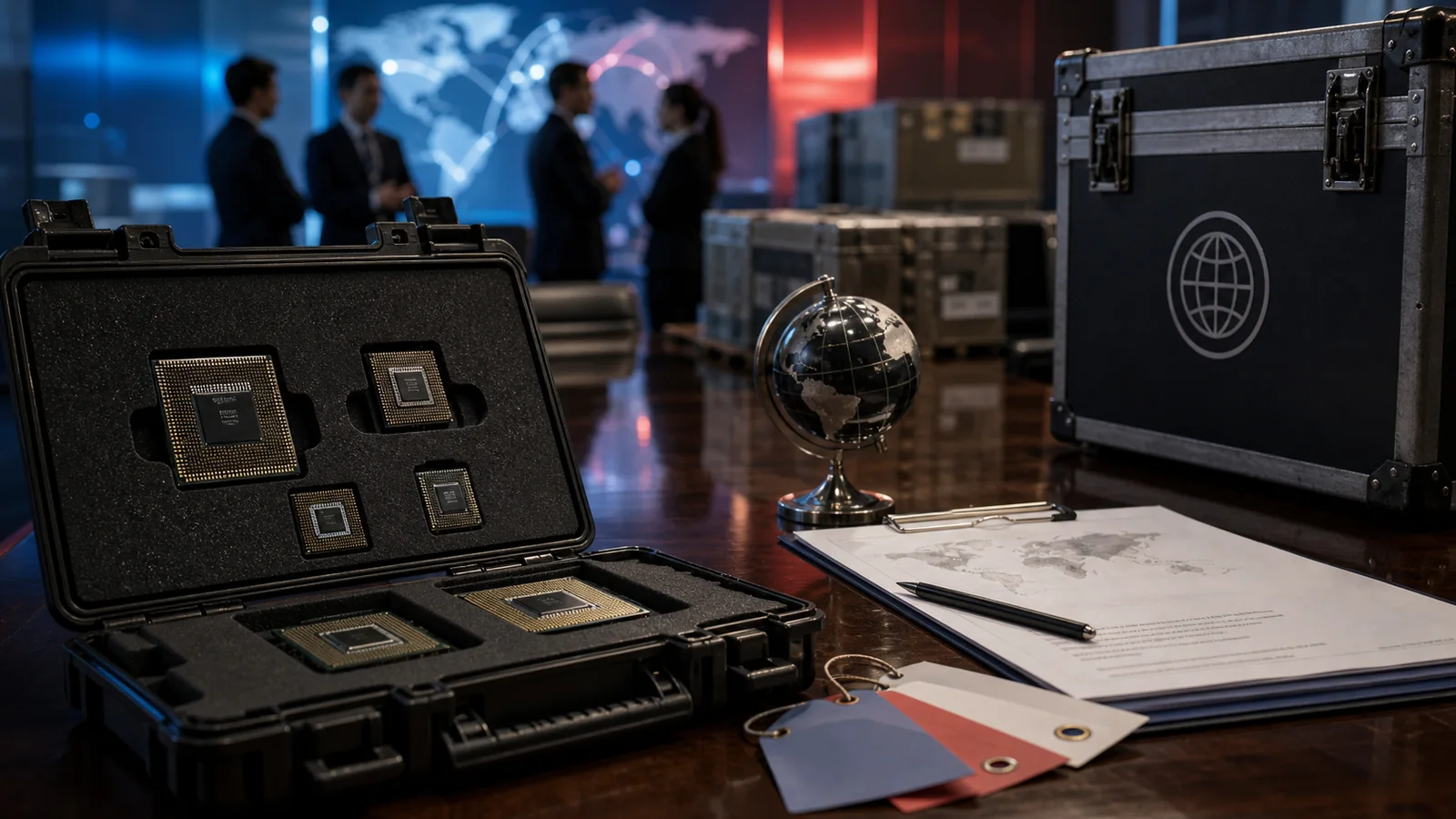
By Marcus Ellery, ReadBasket
Current as of May 13, 2026.
Nvidia’s chips are no longer just products. In the U.S.-China relationship, they have become diplomatic cargo.
That is the signal from Jensen Huang’s last-minute inclusion in President Donald Trump’s China trip. Reuters reported on May 13 that the Nvidia CEO joined the Beijing visit, raising hopes in China that the summit could help unfreeze the long-stalled effort to sell Nvidia’s H200 AI chips to Chinese customers. The detail matters because the H200 is not just another semiconductor. It is a test case for how Washington wants to balance AI leadership, national security, trade leverage and corporate revenue.
For investors, executives and anyone watching the AI economy, the message is blunt: the most important chips in the world now move through diplomacy as much as supply chains. A data center does not get built only because a company wants GPUs. It gets built because export rules, customs rules, security tests, government approvals, buyer confidence and geopolitical timing line up.
Why The H200 Matters
The H200 is powerful enough to matter to AI developers and sensitive enough to worry national-security officials. Reuters reported that the Trump administration authorized China-bound H200 sales late last year and gave a formal green light in January 2026 under conditions. Yet, as of the May 13 Reuters report, no H200 chips had been sold to Chinese customers.
That gap between permission and actual shipments is the whole story. Washington can approve a pathway. Beijing can still hesitate. Chinese buyers can want the chips. Regulators can still set conditions. Nvidia can restart parts of the supply chain. Sales can still be blocked by politics, verification, security fears or terms neither side likes.
The U.S. Commerce Department’s Bureau of Industry and Security said in January that license applications for Nvidia H200, AMD MI325X and similar chips would be reviewed case by case if certain security requirements are met. Those requirements include showing that exports would not reduce global semiconductor production capacity available to U.S. customers, that Chinese purchasers have export-compliance procedures, and that products undergo independent third-party testing in the United States to verify performance and security.
The Trade-Off Washington Cannot Escape
The U.S. wants several things at once. It wants American chipmakers to dominate global AI infrastructure. It wants U.S. companies to earn revenue in major markets. It wants China to stay behind on frontier AI capability. It wants supply chains that strengthen American manufacturing. It wants allies and investors to believe U.S. rules are predictable.
Those goals do not always fit cleanly together. A stricter export-control regime may slow China’s AI developers, but it can also push Chinese customers toward domestic alternatives. A looser regime may support Nvidia’s revenue and keep Chinese AI firms dependent on American hardware, but critics argue it could narrow the U.S. lead in advanced AI and strengthen Chinese military or surveillance capabilities.
That is why Huang’s presence in Beijing is more than optics. Nvidia is not just lobbying for access to a customer base. It is arguing, implicitly or explicitly, that keeping U.S. chips in the Chinese market may be better for American influence than forcing Chinese companies to accelerate substitutes.
China’s Alternative Plan Is Getting Funded
The other side of the story is China’s domestic chip push. South China Morning Post reported on May 8 that Baidu’s AI chip unit Kunlunxin is seeking a valuation of at least 100 billion yuan, or about $14.7 billion, for a Hong Kong listing, while also pursuing a mainland listing process. Bloomberg has also reported that Kunlunxin is planning a dual listing structure involving Shanghai’s STAR Board and Hong Kong.
That does not mean China’s homegrown AI chips are equal to Nvidia’s most advanced products today. Reuters reported that Chinese companies still see Nvidia’s hardware as unmatched at the frontier. But markets do not require equality to shift. They require direction. If export controls make access uncertain, capital will flow toward domestic alternatives, even if those alternatives are not yet best-in-class.
This is the strategic tension. Every delay in H200 access is also an advertisement for China’s self-reliance story. Every conditional approval is also a reminder that American hardware remains deeply desirable. Both statements can be true at the same time.
Why Investors Should Watch The Politics, Not Just The Orders
This is not investment advice. But for market watchers, the chip trade has become a policy trade. Nvidia’s demand story is still extraordinary, but China exposure is no longer a simple sales line. It is a variable shaped by export licenses, summit agendas, enforcement rules, Chinese customs decisions, domestic substitution and U.S. political criticism.
The same applies beyond Nvidia. AMD, memory suppliers, server makers, foundries, cloud companies and data-center builders are all exposed to the broader question: where will AI compute be allowed to flow? If a GPU is treated like strategic infrastructure, then earnings forecasts have to consider policy risk alongside ordinary supply and demand.
The market tends to like clarity. The AI chip market increasingly runs on ambiguity. Approval may not mean shipment. Shipment may not mean scale. Scale may not survive the next policy change.
The Diplomatic Cargo Problem
Calling AI chips diplomatic cargo is not a metaphor for drama. It is a practical description. These chips now carry the weight of national strategy. They are commercial goods, military-adjacent technology, industrial-policy tools, bargaining chips and economic indicators at once.
That creates a strange burden for companies. Nvidia has to satisfy shareholders, customers, Washington, security hawks, Chinese buyers and a supply chain that needs predictability. The U.S. government has to decide how much access is too much. China has to decide whether buying American chips helps its AI industry now or weakens its self-reliance argument later.
The result is not a clean decoupling. It is a managed entanglement. Both sides want leverage. Both sides want optionality. Neither side wants to be fully dependent, but neither side can ignore the performance gap or the revenue opportunity.
What To Watch Next
- Actual H200 shipments: approvals matter less than whether Chinese customers receive chips at meaningful scale.
- Chinese buyer permissions: Beijing’s own controls may be as important as Washington’s export licenses.
- Kunlunxin’s listing path: a high-profile IPO would show investor appetite for domestic AI chip alternatives.
- U.S. enforcement details: third-party testing, customer screening and volume conditions will determine how usable the policy is.
- Cloud buildout plans: the real test is whether Chinese AI labs can access enough compute to train and serve competitive models.
The Bottom Line
Jensen Huang’s China trip matters because it shows how deeply AI chips have moved into statecraft. The H200 is no longer merely a product waiting for a purchase order. It is a negotiation over technological dependence, corporate revenue, military risk and who controls the compute layer of the AI economy.
For the U.S., the question is how to sell enough to keep influence without giving away too much capability. For China, the question is how to buy what it needs while building what it cannot reliably import. For Nvidia, the question is how to remain the indispensable supplier in a market where indispensability itself has become politically dangerous.
The AI boom is often described as a race for models. It may be more accurate to call it a race for permission to compute.
Read next: Was AI a Bubble, or Did Revenue Arrive?
Sources
- Reuters via MarketScreener: Nvidia CEO joins Trump for China trip
- Associated Press: Markets swing as AI chip and policy news moves tech stocks
- U.S. Bureau of Industry and Security: Revised license review policy for semiconductor exports to China
- South China Morning Post: Baidu chip unit Kunlunxin eyes valuation in Hong Kong IPO