 Jeff McGilligan
By Jeff McGilligan, ReadBasket
Does SEO still matter in the age of AI? Yes, but the lazy version of SEO is running out of road. The version built on thin rewrites, neat keyword repetition, and articles that say what every other article already says is becoming easier for AI search to compress, summarize, or ignore. The version built on useful pages, original experience, technical clarity, strong internal links, credible authors, and reader trust still matters a great deal. In fact, it may matter more now because AI systems need sources to understand, cite, compare, and explain.
The confusion comes from the word “SEO” itself. If SEO means chasing a blue-link ranking and measuring success only by raw clicks, then AI Overviews, AI Mode, ChatGPT search, Perplexity, Gemini, Claude, and other answer engines have already changed the game. If SEO means making your work discoverable, understandable, authoritative, useful, and worth choosing, then it is not dead. It is being forced to grow up.
Google’s own guidance points in that direction. In its Search Central documentation for AI features, Google says site owners can use the “same foundational SEO best practices” for AI Overviews and AI Mode as they do for ordinary Search. The company also says pages must be indexed and eligible for a snippet to appear as supporting links, and that there are “no additional technical requirements.” That is not Google declaring SEO obsolete. It is Google saying the foundations still count, even as the search interface changes around them.
Google Is Not Abandoning Search. It Is Rebuilding It Around AI.
There is a business reason Google is speaking so carefully here. Search is still one of the most valuable products in the world, and Alphabet’s latest numbers show that AI has not killed it. In Alphabet’s first-quarter 2026 results, Google Search and other revenue rose 19 percent year over year to $60.4 billion. Sundar Pichai said AI experiences were driving usage and that Search queries were at an all-time high.
That matters because the popular argument that “AI will replace Google” is too simple. Google is using AI to defend Search, expand it, and keep people asking more complicated questions inside its ecosystem. AI Mode and AI Overviews are not side projects anymore. They are becoming the place where Google explains the web before sending anyone to it.
On May 6, 2026, Google announced five new updates to generative AI in Search, including further exploration links, labels for news subscriptions, more inline links, website previews on desktop, and more public discussion perspectives from forums and social platforms. The pitch is straightforward: AI search should help users find deeper links, original voices, and sources they trust. The publisher question is less comfortable: will users still click often enough for the open web to benefit?
The Click Problem Is Real
This is where the debate gets tense. Google says AI search can send higher-quality clicks because users arrive with more context. Site owners should take that seriously, especially if their business depends on conversions rather than pageview volume. A smaller audience that reads longer, signs up, buys, subscribes, or returns can be more valuable than a larger audience that bounces in three seconds.
But the traffic pressure is not imaginary. Pew Research Center analyzed U.S. browsing data from March 2025 and found that users who saw an AI summary clicked a traditional search result on 8 percent of visits, compared with 15 percent on pages without an AI summary. Pew also found that users clicked a link inside the AI summary itself on only 1 percent of visits. Ahrefs, using Google Search Console data across 300,000 keywords, reported in February 2026 that AI Overviews correlated with a 58 percent lower average click-through rate for the top-ranking page.
Those numbers do not prove every site loses in every query. They do show why publishers, bloggers, affiliates, retailers, software companies, and local businesses are nervous. A page can be good enough for Google to use as a source and still receive fewer visits than it would have received in the old search layout. That is the uncomfortable middle ground of AI search: visibility may rise while traffic falls.
The New SEO Is Source Strategy
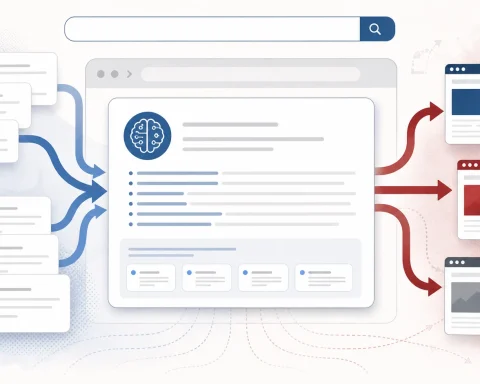
The practical answer is not to quit SEO. It is to stop treating SEO as a pile of formatting tricks. AI-era SEO is closer to source strategy: becoming the page, person, brand, dataset, guide, review, forum thread, tool, or explainer that an answer system can trust enough to surface.
That changes the work. A classic article targeting “best running shoes for beginners” used to compete mostly on keyword coverage, backlinks, title tags, freshness, and maybe product comparison depth. In an AI search result, the system may synthesize shoe-store pages, Reddit threads, podiatrist advice, YouTube reviews, running forums, brand product specs, and publisher rankings into one answer. If your page only repeats common advice, AI can absorb it without needing you. If your page contains original testing, clear criteria, named expertise, actual images, honest tradeoffs, updated prices, and internal links to deeper guides, it has more reason to exist.
That is why Google’s guidance on generative AI content is important. Google does not ban AI-assisted content, but it warns against generating many pages without adding value. Its advice is to focus on accuracy, quality, and relevance, including metadata, titles, descriptions, structured data, and image alt text. In plain English: AI can help with research and structure, but it cannot be the reason your page deserves attention.
What Still Works
The SEO basics still matter because machines need clean signals before they can make smart decisions. Crawlable pages matter. Indexable text matters. Fast pages matter. Descriptive titles matter. Internal links matter. Structured data matters when it matches the visible page. Image alt text matters. Author pages matter. Updated facts matter. Search Console and Google Analytics matter because they show what is changing before gut feeling turns into panic.
The difference is that those basics are now the floor, not the strategy. A site that wants to survive AI search needs more than “helpful content” as a slogan. It needs a reason for readers to prefer the full page over the summary. That reason might be a tool, a checklist, a beautiful chart, a local angle, a personal interview, a tested recipe, a searchable table, a strong opinion, a human story, or a comparison that took real work.
For publishers and small sites, internal linking becomes more important, not less. If a reader arrives from an AI answer, the article needs to make the next useful step obvious. A good internal link is not just an SEO signal. It is editorial hospitality. It tells the reader, “If this helped, here is the next thing that will help more.” That is also why old articles should not sit untouched. They should be refreshed, connected, and shaped into topic clusters that make the site look coherent to people and machines.
What To Do Now
For a business, blog, or publication, the next move is not complicated, but it does require discipline. Start by identifying the pages that actually deserve to represent you. Improve those first. Add firsthand detail. Remove filler. Make the title clear. Answer the main question early. Add internal links to related pieces. Use images that support the text instead of decorating it. Check that the article still reflects the latest facts. Then watch Search Console for impressions, clicks, and queries where AI Overviews may be changing behavior.
Also measure beyond the click. If AI search sends fewer visitors but those visitors spend longer, read more pages, join a newsletter, request a quote, or buy, the page may still be working. If impressions rise and clicks drop, the page may be getting summarized. If rankings hold but traffic falls, the search layout may be stealing attention. If branded searches grow, your broader reputation may be improving even when article clicks look flat.
The smartest SEO teams will stop arguing about whether AI killed SEO and start asking better questions. Are we a source worth citing? Are we publishing anything that cannot be guessed from ten competitor pages? Are our authors credible? Are our old posts linked together sensibly? Are our images and data useful? Would a reader bookmark this, share it, or come back next week?
The Bottom Line
SEO still matters in the age of AI, but it is no longer enough to optimize for a crawler and hope the human finds value later. The human value has to be obvious first. AI search is very good at flattening average content. It is less good at replacing original reporting, real testing, lived expertise, strong editorial judgment, useful tools, and trust built over time.
The old SEO question was, “How do we rank?” The better question now is, “Why should this page be chosen as a source?” Sites that can answer that honestly still have a future in search. Sites that cannot may discover that AI did not kill their SEO. It simply revealed that there was not much there to protect.
Read next: Google AI Search Is Turning Reddit And Forums Into The New Expert Layer
Sources
- Google Search Central: AI features and your website
- Google Search Central: Top ways to ensure your content performs well in Google’s AI experiences on Search
- Google Search Central: Guidance on using generative AI content on your website
- Google: 5 new ways to explore the web with generative AI in Search
- Alphabet: Q1 2026 earnings release
- Pew Research Center: Google users are less likely to click when an AI summary appears
- Ahrefs: AI Overviews reduce clicks update