 Jeff McGilligan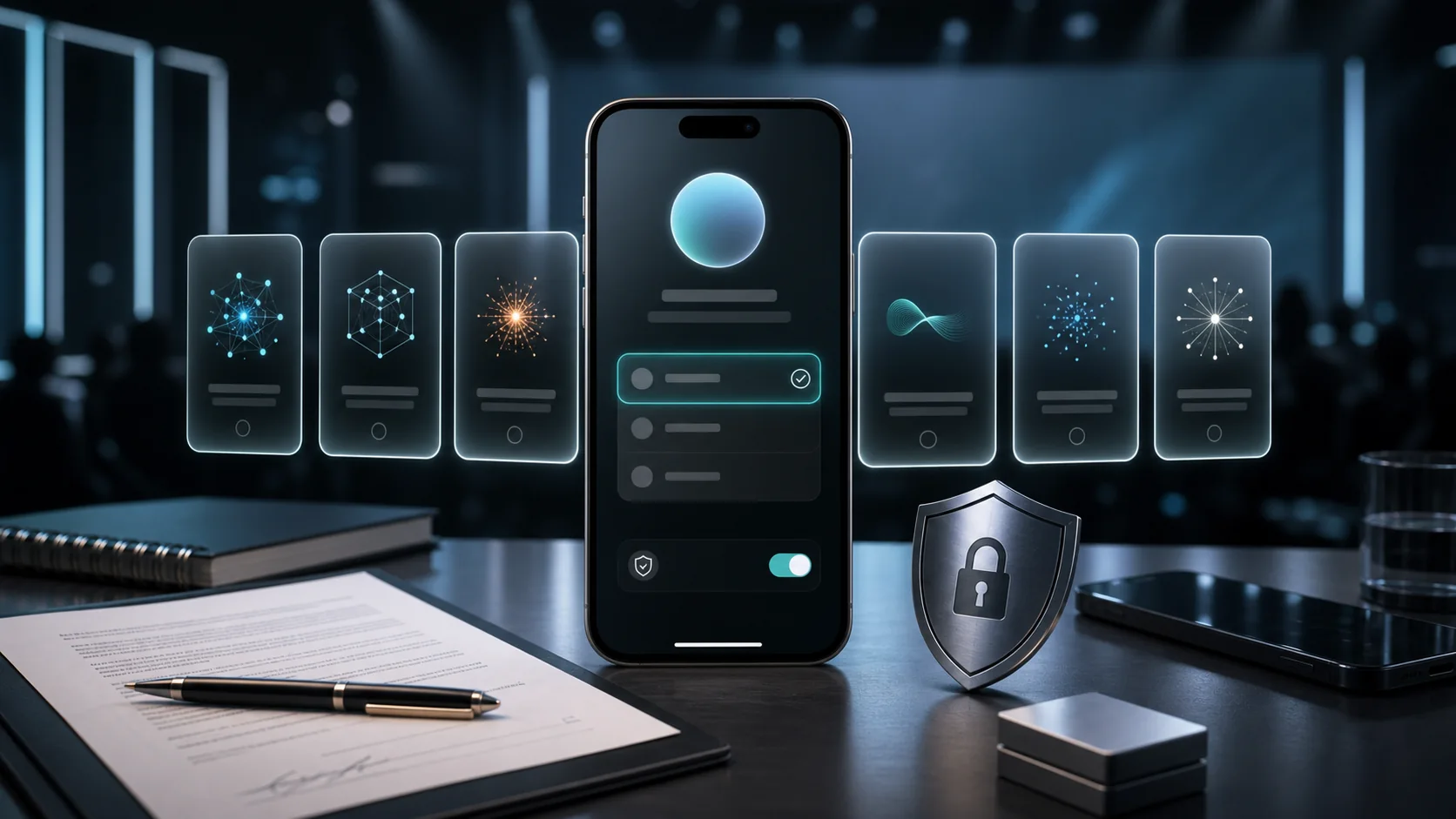
By Jeff McGilligan, ReadBasket
Apple’s next AI story may not be about one smarter Siri demo. It may be about Apple admitting, quietly but unmistakably, that the iPhone’s AI future cannot depend only on Apple. After a proposed $250 million Siri settlement and fresh reporting that iOS 27 could let users choose rival AI models across Apple Intelligence features, the more interesting question is no longer whether Apple can catch OpenAI, Google, Anthropic, and Microsoft on model performance. It is whether Apple can turn model choice into the next version of iPhone trust.
The timing is awkward and revealing. Apple sold the iPhone 16 cycle with major Siri and Apple Intelligence promises. According to AP, a class-action lawsuit alleged that Apple marketed AI features that did not yet exist, and Apple has now agreed to a proposed $250 million settlement that could pay eligible U.S. iPhone buyers up to $95 per device if approved by a judge. Apple has not delivered the full Siri overhaul two years later, while rivals have spent that period shipping faster AI assistants, workplace agents, multimodal models, and search-style answer tools.
That would be a normal product-delay story if Apple were only missing one feature. But the iOS 27 reporting makes it bigger. Reuters, citing Bloomberg News, reported on May 5 that Apple plans to let users select third-party AI models for tasks such as text and image generation across iOS 27, iPadOS 27, and macOS 27. The reported feature, internally called Extensions, would let compatible AI providers power Apple Intelligence features through the Settings app. Google and Anthropic have reportedly been tested internally, while OpenAI already has a live ChatGPT integration with Apple Intelligence.
Apple’s AI Problem Is Trust, Not Just Speed
For years, Apple’s strongest consumer promise was simple: buy the iPhone and Apple will make the complicated technology feel private, polished, and safe. That worked well for cameras, payments, messaging, silicon, and app distribution. AI is harder. The best model for summarizing an email may not be the best model for writing code, searching photos, answering a medical-adjacent question, editing an image, or handling a sensitive business document. The model landscape also changes too quickly for one company to guarantee that its own assistant is always the best option.
That is why model choice could be a bigger Apple move than another Siri promise. If the reporting is accurate, Apple may be shifting from “trust our AI” to “trust our control layer.” In that version of the future, the iPhone is not necessarily the smartest AI brain in the room. It is the device that lets users choose which brain handles which job, while Apple manages permissions, privacy prompts, on-device context, app compatibility, and account boundaries.
That fits Apple’s DNA better than trying to win every benchmark. Apple rarely succeeds by exposing every technical layer to the user. It succeeds by deciding which choices matter and making those choices feel safe. The interesting challenge now is that AI provider choice may matter enough that hiding it could feel paternalistic. A business user may want Claude for long documents, Gemini for Google-connected workflows, ChatGPT for general help, or Apple’s own models for private on-device tasks. A parent may want stricter controls. A developer may care about cost and latency. A journalist may care about data retention. Those are not edge cases anymore.
The Privacy Layer Becomes The Product
Apple has already shown how it wants to frame this. Its Private Cloud Compute system is designed to let more complex AI tasks run on Apple servers while preserving privacy guarantees that ordinary cloud AI services do not always offer. OpenAI’s help page for Apple’s ChatGPT integration also makes clear that data handling depends on whether a user is logged into a ChatGPT account, and says that users can access the integration without logging in. Without an account, OpenAI says it does not receive the user’s IP address, store requests, or use them to train models.
That kind of detail will become more important if Apple opens the gate to more model providers. The question will not be “Which model is smartest?” It will be “What happens to my data when this model handles my prompt?” Apple can make that understandable with settings, labels, permission flows, and defaults. It can also make it confusing if the experience becomes a list of AI vendors most people have not meaningfully compared.
This is where Apple has a chance to do something useful. Model choice should not feel like picking an obscure printer driver in 2004. It should feel like choosing a default search engine, payment card, or browser, but with better explanations. The iPhone should be able to show which model is being used, whether the task stays on device, whether it goes to Apple’s private cloud, whether a third-party provider sees the request, and whether an account connection changes the rules.
Why WWDC Matters More This Year
Apple’s Worldwide Developers Conference starts June 8, 2026, and Apple has already said WWDC26 will include AI advancements alongside new software and developer tools. That gives Apple a narrow window to reset the story before the next iPhone cycle. Developers need to know whether Apple Intelligence is becoming a closed Apple feature set, an AI routing layer, or a platform where apps can bring their preferred models into system features.
The developer angle is not just technical. If Apple lets model providers opt in through App Store apps, it could create a new distribution battle. AI companies would have a reason to make their iOS apps more deeply compatible with Apple Intelligence. Apple would have another lever to keep AI activity inside its platform rules. Users would get choice, but that choice would still be framed by Apple’s store, settings, privacy language, and approval process.
That could also ease regulatory pressure. Apple has been criticized for controlling too much of the iPhone experience. Letting users choose AI models would give Apple a consumer-friendly answer: the iPhone is not locking users into one assistant. At the same time, Apple would still control the interface through which that choice happens. In other words, openness becomes another Apple-designed experience.
The Risk: Choice Without Clarity
The danger is that Apple turns a trust problem into a settings problem. Most people do not want to manage five model providers. They want their phone to work. They want Siri to understand context, write messages, search photos, summarize emails, control apps, and answer questions without creating a privacy headache. If model choice becomes too technical, normal users may leave defaults untouched, which means Apple still carries the trust burden even when a third-party model is behind the answer.
Apple also needs to avoid overpromising again. The Siri settlement is a warning flare because it attacks the company’s credibility around marketing unfinished AI. A good WWDC demo is not enough. Apple needs dates, limitations, privacy details, developer documentation, and a clear distinction between features that are shipping and features that are still aspirational.
If Apple gets this right, the iPhone could become the place where AI choice feels normal instead of chaotic. If it gets it wrong, Apple Intelligence risks becoming a label for delayed features, confusing integrations, and a Siri brand that still sounds more capable on stage than it feels in a user’s hand.
The smartest version of Apple’s AI reset is not “Siri beats everyone.” It is “the iPhone helps you choose the right AI without losing control of your data.” That would be a more Apple answer to the AI race than chasing every benchmark. It would also be a much better story to tell after a quarter-billion-dollar reminder that trust is easier to market than to earn.
Read next: Grok 4.3 Is Not Just Another Model Drop. It Is a Price War for AI Agents.
Sources
- AP: Some iPhone owners could get up to $95 payment after Apple agrees to settle case for $250 million
- Reuters via Investing.com: Apple to let users choose rival AI models across iOS 27 features
- Apple: WWDC returns the week of June 8
- Apple Security Research: Private Cloud Compute
- OpenAI: How your data is handled through Apple’s ChatGPT integrations