 Clara Bennett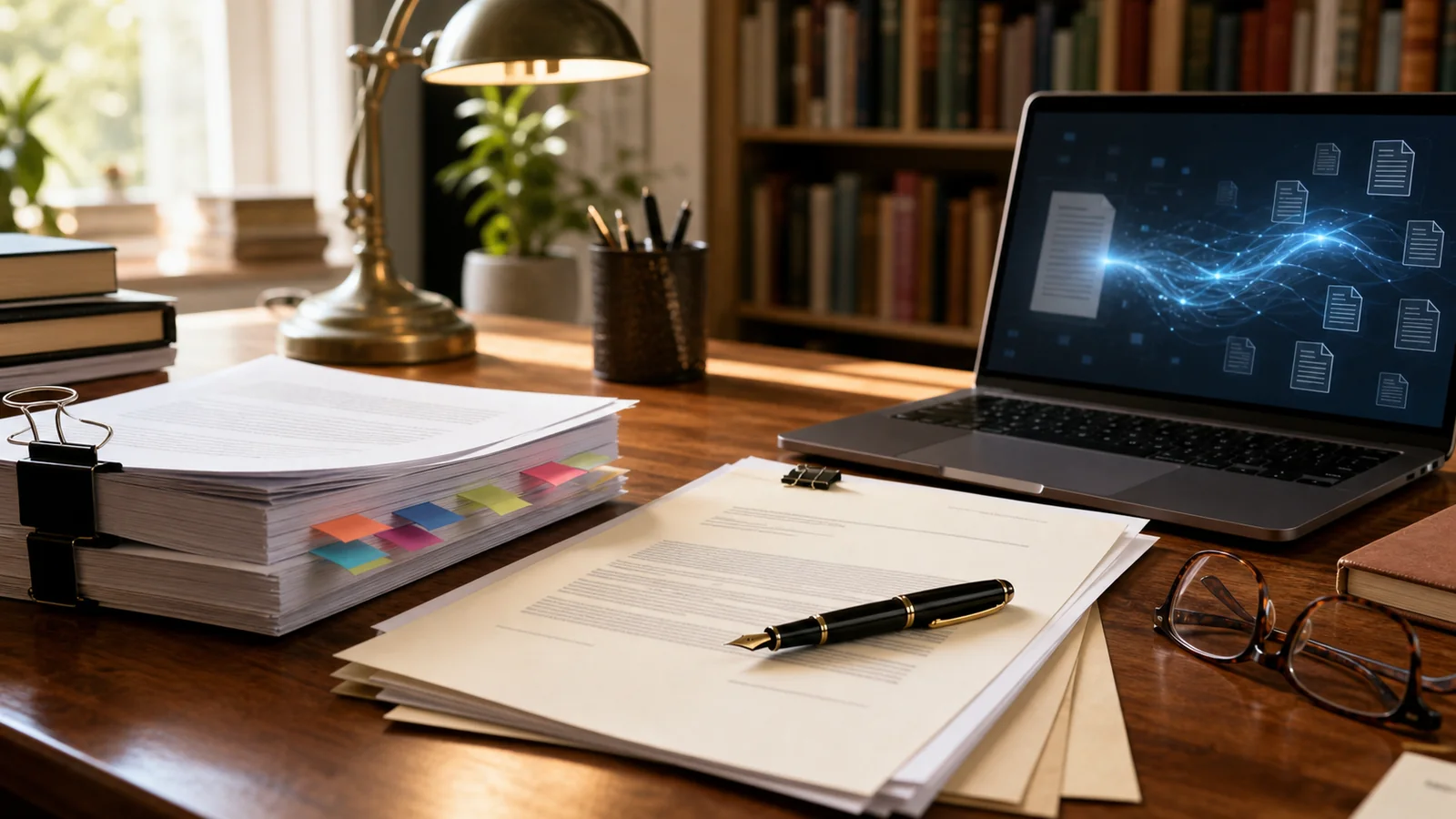
By Clara Bennett, ReadBasket
Current as of May 13, 2026.
The AI writing debate has finally reached the most unromantic part of the book world: the contract.
That may sound dull, but it is where the argument becomes real. A novelist can have an opinion about AI. A publisher can have a policy. A reader can have a feeling. But a publishing contract asks something sharper: who wrote this manuscript, what rights are being granted, what was disclosed, and what happens if one side got the answer wrong?
On May 11, 2026, the Authors Guild updated its AI best practices for authors. Publishers Weekly highlighted one of the most consequential warnings: AI-generated text is not copyrightable, and undisclosed AI-generated text may create problems with copyright registration and contract warranties. The Guild’s message is not simply “never touch AI.” It is more practical and, frankly, more serious: if AI enters the writing process, authors need to understand where it sits legally, ethically and commercially.
The Word That Matters Is “Original”
Most readers think of originality as a creative question. Is the book fresh? Is the voice alive? Does it feel like one person looking at the world in a way nobody else quite does?
Contracts use originality differently. They often require the author to represent and warrant that the manuscript is original to the author. That language matters because AI-generated material is not treated as human authorship in the same way. The Authors Guild warns that including AI-generated text in a final manuscript may violate that warranty and, in some cases, put the writer in breach.
This is the quiet nightmare version of the AI writing boom. Not a dramatic scandal where a celebrity author is exposed. A routine rights problem. A registration that needs correction. A publisher that asks whether a chapter was generated. An agent who realizes the manuscript warranty is suddenly more complicated than it used to be.
Not All AI Use Is The Same
The most useful part of the Authors Guild guidance is that it does not pretend every use of AI is identical. There is a difference between asking a tool to help organize research notes, using grammar software, brainstorming chapter questions, summarizing public-domain background material, and pasting generated paragraphs into a book that will be sold as human-authored work.
That distinction is where the future of publishing policy probably lives. A blanket “AI was used” disclosure may be too vague to help anyone. A more useful approach asks: Did AI generate text that appears in the manuscript? Did a human rewrite it substantially? Was confidential material uploaded? Was another writer’s voice mimicked? Did an editor, ghostwriter or book coach use AI without telling the author?
The answer changes the risk. A spell-checker is not the same as a chapter generator. A research prompt is not the same as a scene written in the style of a living novelist. A tool used privately as a sounding board is not the same as undisclosed AI text in a published book.
The Copyright Problem Is Bigger Than Ownership
The U.S. Copyright Office has made the basic principle clear: copyright protects human authorship, not purely machine-generated expression. A work that combines human authorship with AI-generated material may still be registrable, but the AI-generated portions may need to be disclosed and disclaimed.
For authors, that turns AI from a creative tool into a paperwork issue. If a publisher registers copyright on behalf of the author, the publisher needs accurate information. If AI-generated text appears in the manuscript and nobody discloses it, the registration may be vulnerable. If the author later wants to enforce rights, the uncertainty can become expensive.
This is why “nobody will know” is a terrible business strategy. The risk is not only reputational. It can touch copyright, warranties, indemnities, subsidiary rights, audiobook rights, translation rights and contracts with collaborators.
The Collaborator Trap
One of the smartest parts of the Guild’s guidance concerns third parties. Many books are not made by one person alone. Authors work with ghostwriters, editors, researchers, translators, book coaches, packagers, indexers and publicity teams. If any of those people use AI carelessly, the author may still be the one responsible for the final manuscript.
That changes what authors should ask for in writing. A collaboration agreement should not only say who gets paid and who owns what. It should say whether AI tools can be used, whether generated text is allowed, whether confidential material may be uploaded, and whether any AI use must be disclosed before the manuscript is delivered.
For authors who already feel allergic to paperwork, this is annoying. It is also necessary. The publishing industry has entered a period where “I assumed they wouldn’t do that” is not enough.
Readers Care More Than Some Publishers Think
There is a temptation to treat AI disclosure as an inside-baseball legal issue. It is not. Readers care because books are intimate. A novel, memoir or essay collection is not just information. It is a relationship with a voice.
That does not mean every reader will reject every AI-assisted book. Some may not care. Some may care only if AI generated substantial text. Some may accept AI use in a book about AI, a formally experimental project, or a clearly disclosed hybrid work. But readers generally dislike feeling tricked. If a book is marketed around the human sensibility of an author, undisclosed machine-generated prose can feel like a broken promise.
The best publishers will not wait for outrage to set the rules. They will define disclosure standards clearly, explain them to authors and treat reader trust as a commercial asset rather than a public-relations chore.
A Practical Checklist For Authors
This is general information, not legal advice. Authors with contracts, disputes or registration questions should speak to an agent, lawyer or qualified adviser. But the practical checklist is already visible.
- Know what your contract says. Look for warranties about originality, authorship, infringement and AI use.
- Do not paste AI-generated text into a manuscript casually. The legal and disclosure consequences may outlast the convenience.
- Keep records. Track where AI was used for background help, brainstorming, editing support or generated text.
- Protect confidential material. Do not upload unpublished manuscripts, interviews or proprietary research into tools that may train on inputs.
- Ask collaborators directly. Editors, ghostwriters and coaches should disclose any AI use before the manuscript is delivered.
- Discuss disclosure early. Do not wait until copyright registration, marketing copy or publication week.
The Bigger Cultural Shift
AI is forcing publishing to say out loud what it used to leave implicit: books are valuable because readers believe a human mind is behind them. Not every sentence in a book is sacred. Editors shape prose. Researchers gather facts. Translators remake rhythm. Copyeditors save authors from themselves. Publishing has always been collaborative.
But collaboration is not the same as undisclosed substitution. The difference between assistance and authorship is becoming one of the central questions of the industry. The contract is where that difference gets priced, disclosed and enforced.
Authors who use AI carefully may continue to do so. Authors who do not want AI anywhere near their work will need contract language that says so. Publishers that want AI rights will need to ask for them clearly. Readers will keep developing their own instincts about what feels honest.
The Bottom Line
The AI-assisted book is no longer only a creative controversy. It is a contract problem, a copyright problem and a trust problem.
That does not make AI unusable for authors. It makes casual use risky. The writers who navigate this well will not be the ones who pretend the issue is simple. They will be the ones who understand the categories, keep clean records, protect their drafts, disclose what matters and preserve the one thing no tool can really supply: the reader’s belief that a human voice is meeting them on the page.
Read next: The Graphic Novel Boom Has a Creator-Pay Problem