 Clara Bennett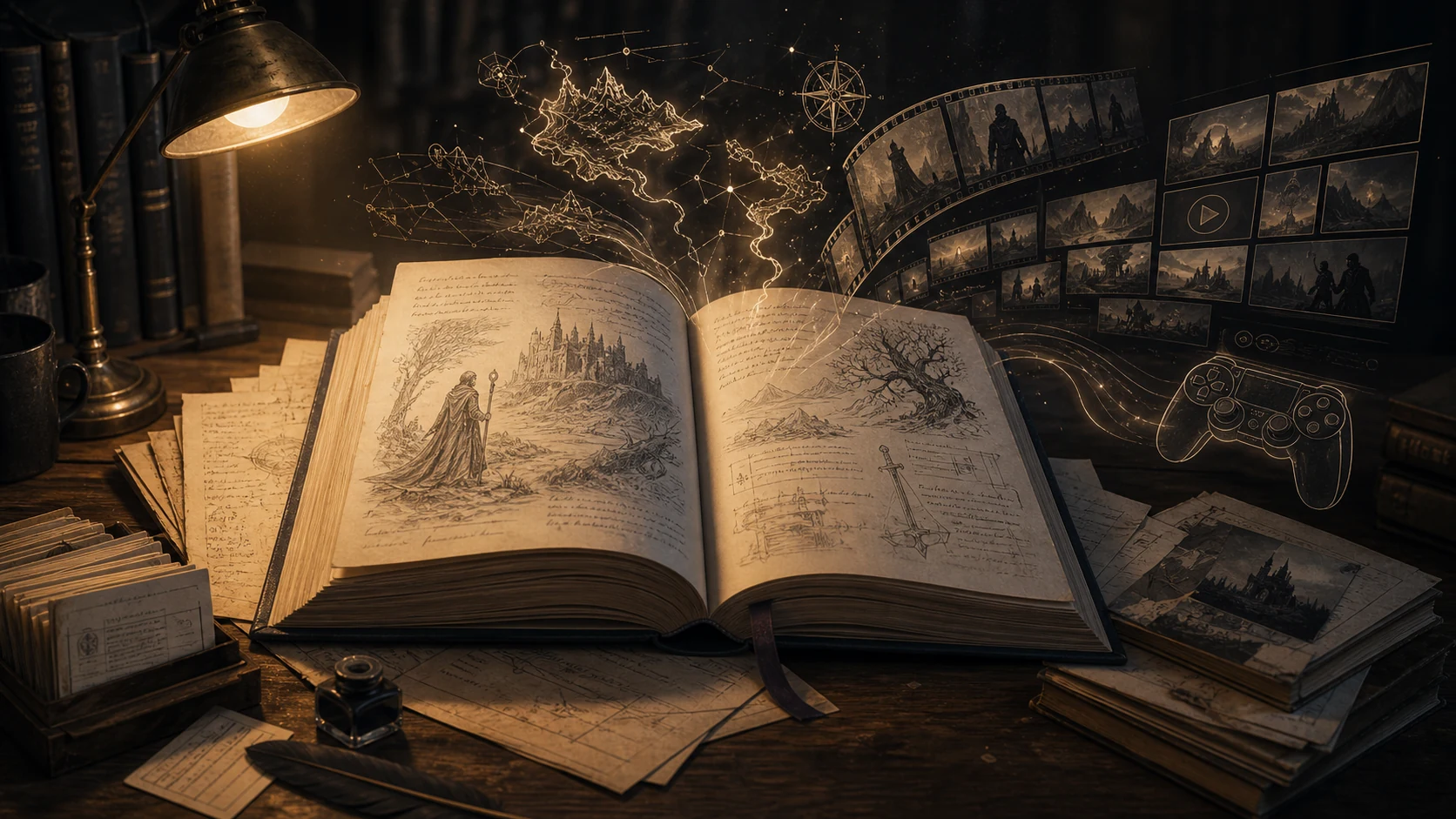
By Clara Bennett, ReadBasket
The Future Is Backstory
The future of fantasy has started to look suspiciously like the past. Not the mythic past inside the stories, with its ancient kings and founding wars, but the industrial past of the franchise itself: the appendix, the companion novel, the throwaway reference, the family tree, the line of dialogue fans circled fifteen years ago and refused to let go.
We are living inside the prequel industrial complex. The Hunger Games is expanding through earlier Panem. The Lord of the Rings keeps finding new routes into Middle-earth. Westeros has become less a single saga than a historical department. Dune has stretched into dynastic television and survival gaming. Harry Potter is being remade for television. Percy Jackson is correcting its own adaptation history on Disney+. Twilight is returning through an animated Midnight Sun, retelling the old romance from another angle.
This is not just nostalgia. Nostalgia is softer than this. What we are seeing is a market structure built around known worlds, dormant fandoms and lore that can be reactivated without asking audiences to learn an entirely new cosmology. In 2024, CNBC noted that the year’s biggest box office titles were dominated by existing IP, with studios leaning heavily into sequels, prequels and remakes. The logic is blunt: audiences are fragmented, marketing is expensive, and familiarity travels faster than originality.
Fantasy is especially vulnerable to this logic because it already comes with maps. A good fantasy world implies more than it shows. There are wars before the first chapter, doomed houses in the margins, vanished cities, prophecies, bloodlines, magical schools, imperial archives. For readers, that depth is part of the pleasure. For studios and streamers, it is inventory.
Panem And The Synchronized Prequel
The cleanest example is The Hunger Games. Suzanne Collins’ Sunrise on the Reaping was published on March 18, 2025, and Scholastic announced that it sold more than 1.5 million World English copies in its first week. The machinery around it was already moving. Lionsgate had announced on June 6, 2024, that it would adapt the novel into a film scheduled for November 20, 2026.
That timing matters. This is no longer the old model in which a book becomes huge, Hollywood notices, and an adaptation follows years later. The modern franchise prequel arrives as a coordinated weather system: publisher announcement, cover reveal, first printing, fan theory cycle, casting speculation, release date, teaser, trailer, theatrical window. The book is still the book, but it also functions as the first phase of a larger reactivation campaign.
Panem is a particularly revealing case because Collins is not simply filling gaps for fun. Her prequels have tended to return to the ideological machinery of the original series: propaganda, spectacle, state violence, public memory. That gives the work more bite than a simple young-version-of-a-familiar-character exercise. Still, the industrial lesson is obvious. A world built to criticize spectacle has become one of the most reliable spectacle engines in contemporary YA-adjacent culture.
Middle-Earth And The Footnote As Real Estate
If Panem shows the synchronized prequel, Middle-earth shows the footnote as real estate. Tolkien’s world has always lived in layers: songs, appendices, lost ages, half-glimpsed genealogies. That is part of why it continues to support expansion. The story feels older than the page it appears on.
In May 2024, Middle-earth Enterprises confirmed that Warner Bros. and New Line were developing new films set in the cinematic universe of The Lord of the Rings, with Peter Jackson, Fran Walsh and Philippa Boyens returning as producers and Andy Serkis attached to direct and star in The Hunt for Gollum. The Motion Picture Association’s publication The Credits later reported a December 17, 2027 theatrical date.
The title is almost too perfect for the era. Gollum is not a footnote in the emotional sense; he is central to the moral architecture of Tolkien’s story. But the hunt itself is exactly the kind of narrative pocket modern franchise culture loves: important enough to feel canonical, narrow enough to be newly dramatized, adjacent enough to brush against beloved icons without remaking the whole quest.
Prime Video’s The Rings of Power works from another end of the archive, turning the Second Age into longform streaming mythology. Meanwhile, games such as Return to Moria and cozy experiments like Tales of the Shire show how Middle-earth can be converted into genres far from the original epic: survival crafting, domestic life, place-based fandom. The franchise no longer asks only what happened next. It asks: what can you do there?
Westeros Learns To Franchise Its History
George R.R. Martin’s world has become the prestige television version of the same pattern. Game of Thrones ended as a cultural argument. HBO’s answer was not to abandon Westeros but to move the camera along the timeline.
House of the Dragon, based on Fire & Blood, is set centuries before Game of Thrones; HBO announced that its third season debuts June 21, 2026. A Knight of the Seven Kingdoms, drawn from the Dunk and Egg novellas, debuted January 18, 2026. These are not interchangeable products. One is dynastic tragedy at scale; the other promises a more grounded wandering-knight texture. Together, they reveal the platform strategy: not one continuation, but multiple tonal lanes within the same world.
That is the streaming-age innovation. A fantasy franchise no longer has to be a single trunk with sequels branching outward. It can become a grid. One series for court politics, one for adventure, one for ancient catastrophe, one for a future war not yet greenlit. The map becomes a programming schedule.
Dune Turns Lore Into Systems
Dune may be the purest example of fantasy and science fiction merging into franchise infrastructure. Denis Villeneuve’s films restored Frank Herbert’s universe to theatrical scale, but the expansion did not stop with the Atreides story. HBO renewed Dune: Prophecy for a second season in December 2024, positioning the Bene Gesserit not as mysterious background texture but as a full television engine.
Then there is Dune: Awakening, Funcom’s open-world multiplayer survival game, which entered its head-start period in June 2025. That move is crucial because games do something different from prequels. They turn lore into systems. Arrakis is not only a setting to admire or decode; it becomes heat, scarcity, travel, extraction, factional pressure. A franchise world reaches a new stage when fans do not simply watch its politics but grind through its logistics.
This is where the industrial complex becomes most visible. The great fantasy worlds are no longer stories alone. They are platforms for different modes of attention: reading, streaming, theatrical attendance, gaming, podcasting, wiki editing, TikTok theorizing, anniversary rereading. The canon becomes less like a shelf and more like a subscription ecosystem.
Remakes Are Prequels To The Next Fandom
Not every expansion goes backward. Some simply restart the clock. HBO’s new Harry Potter series, announced for a Christmas 2026 debut in a March 2026 WBD release, is not a prequel. It is something more culturally revealing: a remake designed to make the original story newly serial, newly castable, newly discussable and newly available to a generation that did not experience midnight book releases or 2000s blockbuster anticipation in real time.
The Percy Jackson revival works differently. Disney+ renewed Percy Jackson and the Olympians for a third season in March 2025 before its second season had premiered, while noting the first season’s strong streaming and social performance. This is the corrective remake as fandom repair. The promise is not merely “here is the story again.” It is “here is the version you always said you wanted.”
Twilight, meanwhile, is taking the alternate-perspective route. Netflix announced in September 2024 that Midnight Sun, Stephenie Meyer’s retelling from Edward Cullen’s point of view, was being developed as an animated series. This is a distinctly modern form of franchise renewal: not sequel, not reboot, not exactly remake, but a shift in angle. The same gravitational event, seen through another consciousness.
That choice understands fandom with eerie precision. Fans do not only want to know what happens. They want to revisit what happened with new emotional permissions. They want the deleted feeling, the missing perspective, the scene behind the scene. In the age of fan edits and reaction videos, perspective itself becomes intellectual property.
The Risk Of Explaining Too Much
There is a danger here, and it is not simply too many prequels. Some prequels are excellent. Some remakes are necessary. Some side quests deepen the original rather than dilute it. The real danger is that fantasy’s most powerful quality, mystery, can be mistaken for unused product.
Not every blank space needs zoning approval. Not every family tree needs dramatization. Not every villain needs a childhood. Wonder depends on distance. A world feels large partly because we cannot see all of it. When every legend becomes content, myth starts behaving like a database.
The better prequels understand this. They do not merely explain; they reframe. They use the past to make the original stranger, sadder or more politically charged. They recognize that a footnote is not valuable because it is empty space. It is valuable because it points toward pressure: the thing the main story could not stop to examine.
That is why The Hunger Games remains more compelling than many franchise expansions. Its returns to the past are not just scavenger hunts for recognizable names. At their best, they ask how a society rehearses cruelty until it looks like tradition. That is a prequel with a reason to exist.
Why The Footnotes Won
The footnotes won because the business changed. Theatrical releases need pre-awareness. Streamers need subscriber-retaining worlds. Publishers need events. Game studios need settings with built-in identity. Fandoms need reasons to wake up again. Anniversaries need merchandise. Algorithms need recognizable names.
But the footnotes also won because readers trained themselves to love them. Fantasy fans have always been archivists. They memorize maps, debate timelines, annotate prophecies, defend minor characters, mourn vanished kingdoms. The industry did not invent that behavior. It monetized it.
The future of fantasy, then, is hidden in the footnotes because the footnotes are where affection and commerce meet. They offer studios a lower-risk path and fans a familiar door. They promise novelty without estrangement. They let a franchise say: you have been here before, but not quite from this angle, not quite this early, not quite this deep in the archive.
The question is whether fantasy can keep producing new worlds while the old ones continue to expand. A culture cannot live on appendices alone. Eventually, somebody has to write the first map, the first prophecy, the first impossible city. The healthiest future is not one without prequels, but one where prequels are not treated as the only safe form of imagination.
For now, the lesson is clear. The next great fantasy event may not arrive as a sequel charging toward tomorrow. It may come disguised as a recovered history, a side quest, a remake, a game mechanic, an alternate point of view, a single sentence from the old text that somebody in a boardroom and somebody on a fan forum both noticed at the same time.
In the prequel industrial complex, the margins are no longer marginal. They are where the money is. Sometimes, if we are lucky, they are where the meaning is too.
Read next: BookTok Bestseller Lists Are Changing How Books Become Hits
Sources
- CNBC: Box office and existing intellectual property
- Scholastic: Sunrise on the Reaping first-week sales
- Lionsgate via Nasdaq: Sunrise on the Reaping film announcement
- Middle-earth Enterprises: New Lord of the Rings films
- The Credits: The Hunt for Gollum release timing
- WBD: A Knight of the Seven Kingdoms debut
- WBD: House of the Dragon season three
- WBD: Dune Prophecy renewal
- Funcom: Dune Awakening head start
- Disney+: Percy Jackson season three greenlight
- Netflix Tudum: Midnight Sun animated series